

Dear Reader,
Please find below our summary of the week’s developments in the Indian equity markets.
Indian equities navigated another turbulent week ended September 25, as US Treasury yields surged to near two-decade highs, crude oil prices stayed volatile amid US-Iran negotiations over the Strait of Hormuz and a deepening governance dispute at Tata Sons kept investors on edge, even as a modest recovery in Friday’s session offered some relief after the week’s earlier declines.
Weekly Overview
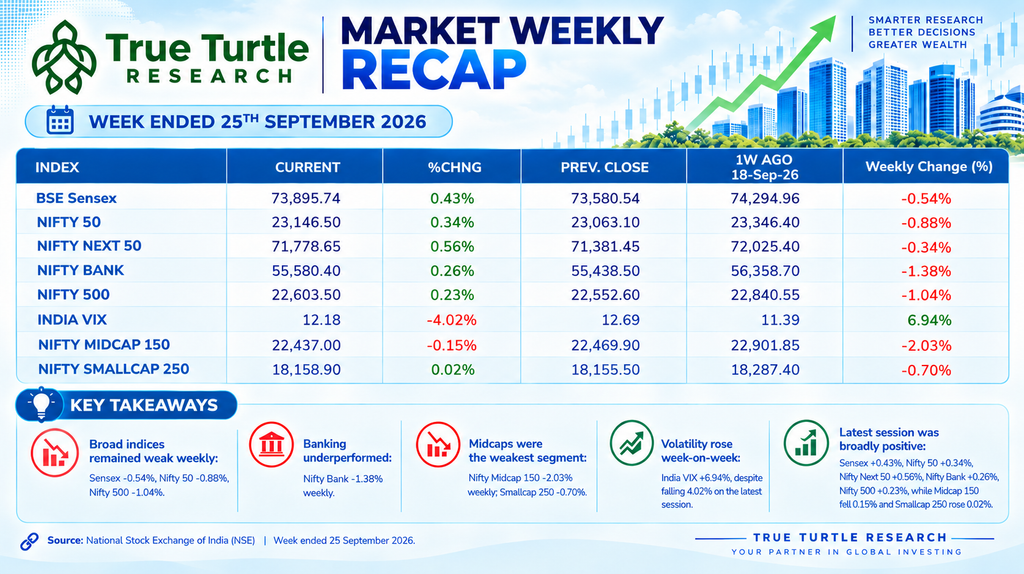
Indian equity markets ended the week on a broadly weak note, with a modest recovery in Friday’s session unable to fully offset sustained declines earlier in the week. The Nifty 50 rose 0.34% on the day to close at 23,146.50, while the BSE Sensex advanced 0.43% to settle at 73,895.74. On a weekly basis, however, the Sensex slipped 0.54% and the Nifty 50 fell a sharper 0.88% versus the previous week’s close, as persistent selling pressure through the week outweighed the late recovery.
Performance across the broader market mirrored this weakness. The Nifty Next 50 rose 0.56% on the day to close at 71,778.65, but still ended the week lower by 0.34%. The Nifty 500 advanced 0.23% on the day yet slipped 1.04% for the week, while the Nifty Bank index, up 0.26% on the day to close at 55,580.40, was among the sharpest laggards on a weekly basis, ending the week down 1.38%. Among the broader indices, the Nifty Midcap 150 was the weakest performer, slipping 0.15% on the day and ending the week down a steep 2.03% — the sharpest weekly decline among major indices — while the Nifty Smallcap 250 was little changed on the day, up 0.02%, but still finished the week lower by 0.70%.
Meanwhile, the India VIX fell 4.02% on the day to close at 12.18, even as it climbed a sharp 6.94% over the week, pointing to elevated underlying volatility beneath the calmer Friday finish. Overall, the week was characterised by broad-based weekly declines across benchmark and broader indices — extending the Nifty and Sensex’s losing streak to a seventh consecutive week, their longest such run since the COVID-19-led crash of February-March 2020 — alongside rising volatility, continued underperformance in banking and mid-cap stocks, and only a partial cushion from Friday’s relief rally.
Weekly Performance of Key Indices
Key Market Triggers
● US Treasury Yields Surge Past 5%, Hit Near Two-Decade High: The US 10-year Treasury yield climbed as high as 5.23% during the week, its highest level since 2007, as a hotter-than-expected September flash composite PMI, hawkish commentary from Fed Governor Michael Barr and soft demand at the week’s Treasury auctions reinforced expectations of further policy tightening. The CME FedWatch tool showed the probability of an October rate hike rising to around 66.4% by Friday, up from about 57.6% a week earlier, keeping global risk sentiment on edge.
● Crude Oil Stayed Volatile Before Easing On US-Iran Truce Hopes: Brent crude spiked to nearly $108 a barrel mid-week amid renewed Houthi attacks and a continued standoff over the Strait of Hormuz, before easing to around $104-105 a barrel by Friday as US and Iranian negotiators explored a phased deal under which Tehran would reopen the strait in exchange for Washington easing its naval blockade. Brent still ended the week modestly higher, even as WTI crude fell sharply on hopes of easing supply risk.
● Rupee Recovered From Near ₹96/Dollar Lows: The rupee, which slipped to an intra-week low near ₹96.07 per dollar on September 24 under pressure from elevated crude prices and surging US yields, staged a partial recovery to close at ₹95.80 per dollar on Friday, up 19 paise on the day, aided by improved risk sentiment and likely RBI intervention through state-run banks.
● Forex Reserves Post Sharpest Weekly Fall In Nearly Two Years: India’s foreign exchange reserves fell by $14.88 billion to $765.90 billion for the week ended September 18, as per RBI data released during the week, marking the steepest weekly decline in nearly two years as the central bank stepped up dollar sales to defend the rupee amid the oil-driven pressure.
● Tata Sons Governance Dispute Deepened: Tata Sons on September 24 formally rejected objections raised by Tata Trusts Chairman Noel Tata over N. Chandrasekaran’s reappointment as Executive Chairman, maintaining that its board had followed valid legal and governance procedures under the company’s Articles of Association. Tata Trusts, which holds roughly 66% of Tata Sons, continues to dispute the validity of the September 17 resolution, keeping the prospect of a legal battle over the group’s leadership and listing plans alive.
● NSE’s Mega IPO Made Its Market Debut: Shares of the National Stock Exchange listed on the BSE on September 24 at ₹1,800 apiece, a premium of 0.84% to the ₹1,785 issue price, and settled around 1% higher on listing day, capping a ₹22,562 crore initial public offering one of the largest in Indian capital markets history that was subscribed 5.71 times.
● FIIs Extended Their Selling Streak: Foreign institutional investors remained net sellers of Indian equities through the week, offloading a net of roughly ₹11,490 crore between September 21 and 25, as elevated US yields and a firmer dollar continued to weigh on sentiment. Continued domestic institutional buying, along with a brief bout of FII buying on Friday, helped cushion some of the impact on the headline indices.
Weekly Sectoral Performance
(Source: NSE)
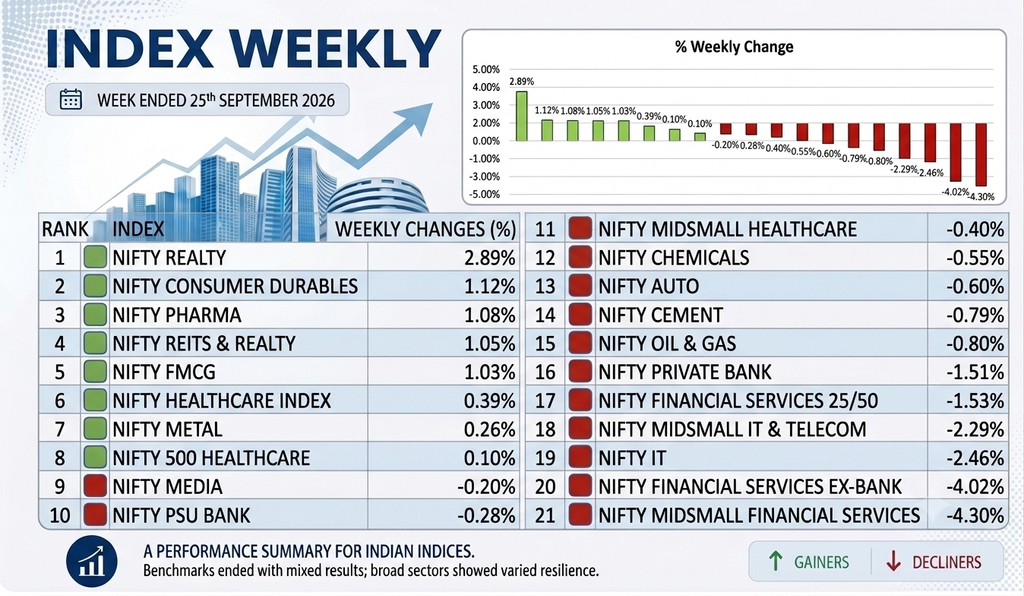
With respect to sectoral performance during the week, gains were led by realty and consumption-linked segments. The Nifty Realty index topped the gainers’ chart with a sharp rise of 2.89%, followed by the Nifty Consumer Durables index, up 1.12%. The Nifty Pharma index added 1.08%, while the Nifty REITs & Realty and Nifty FMCG indices rose 1.05% and 1.03%, respectively. The Nifty Healthcare Index gained 0.39%, followed by the Nifty Metal index, up 0.26%, while the Nifty 500 Healthcare index rounded out the week’s gainers with a modest advance of 0.10%.
Conversely, the Nifty Media index led the week’s laggards with a decline of 0.20%, followed by the Nifty PSU Bank index, down 0.28%. The Nifty Midsmall Healthcare and Nifty Chemicals indices slipped 0.40% and 0.55%, respectively, while the Nifty Auto index fell 0.60%. The Nifty Cement and Nifty Oil & Gas indices declined 0.79% and 0.80%, respectively. Banking and financial services indices were among the sharpest laggards, with the Nifty Private Bank down 1.51% and the Nifty Financial Services 25/50 index down 1.53%. The Nifty Midsmall IT & Telecom index fell a sharper 2.29%, while the Nifty IT index declined 2.46%. The Nifty Financial Services Ex-Bank index was among the weakest performers, down 4.02%, while the Nifty Midsmall Financial Services index recorded the steepest decline of the week, falling 4.30%, rounding out the week’s sectoral decliners. Overall, it was a comparatively weak week for sectoral indices, with realty, consumer durables and pharma leading the gains even as financial services, IT and midsmall financials bore the brunt of the selling.
Wrapping Up
Indian equities navigated a turbulent week, as surging US Treasury yields nearing two-decade highs, continued volatility in crude oil prices amid the US-Iran standoff over the Strait of Hormuz and a deepening governance dispute at Tata Sons weighed on investor sentiment. The Nifty 50 and Sensex extended their losing streak to a seventh consecutive week their longest such run since the COVID-19 led crash of early 2020 even as a modest recovery in Friday’s session offered some relief after the week’s earlier declines. A partial rebound in the rupee, easing crude prices through the back half of the week and the successful listing of the NSE’s mega initial public offering provided a degree of cushion against the broader uncertainty, even as rising volatility and continued foreign outflows kept sentiment fragile. Markets are likely to remain sensitive to further developments in the Tata Sons Tata Trusts dispute, the trajectory of US bond yields and Federal Reserve commentary, and progress on US Iran talks over the Strait of Hormuz. Going forward, investors are likely to closely monitor crude oil price movements, the rupee’s trajectory, foreign institutional investor flows and fresh cues from US economic data for further direction in the market.
