

Dear Reader,
Please find below our summary of the week’s developments in the Indian equity markets.
Indian equities ended a holiday-shortened week sharply lower, as growing expectations of an RBI rate hike, crude oil climbing back to around $100 a barrel, US Treasury yields at multi-decade highs and persistent foreign selling pushed the Sensex to a fresh 52-week low and left the Nifty 50 with an eighth straight weekly loss.
Weekly Overview
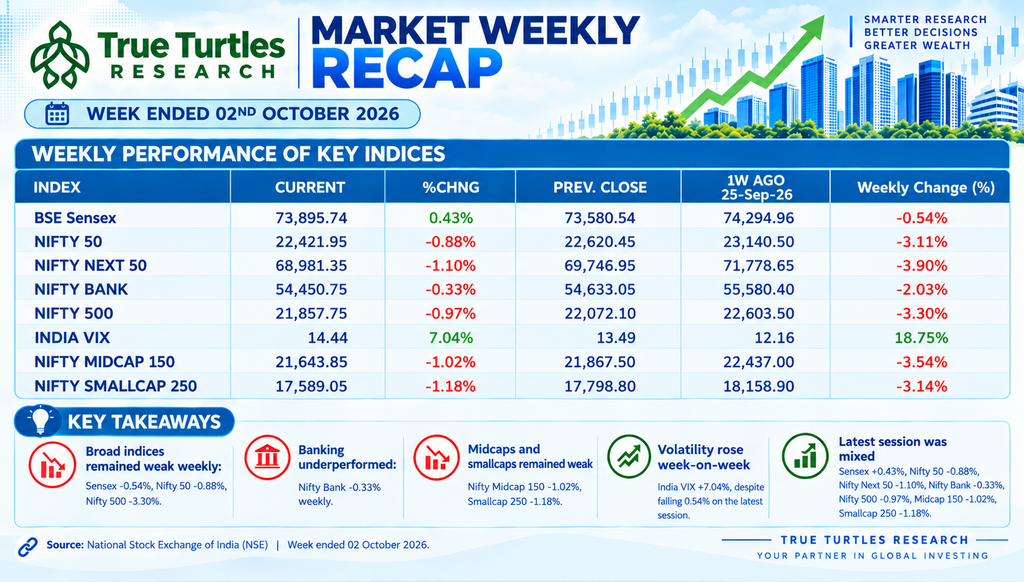
Indian equity markets ended the holiday-shortened week firmly in the red, with benchmark indices extending losses for a fourth consecutive session on Thursday, October 1, the final trading day of the week, as exchanges remained shut on Friday for Gandhi Jayanti. The Nifty 50 fell 0.88% on the day to close at 22,421.95, while the BSE Sensex slipped 0.79% to settle at 71,909.70, after touching an intraday low of 71,292.88, a fresh 52-week low. On a weekly basis, the Nifty 50 lost 3.11% and the Sensex declined 2.68%, with the Nifty recording its eighth consecutive weekly fall. For the month of September, the Sensex ended 5.81% lower and the Nifty 50 declined 6.00%.
Weakness was broad-based across the wider market. The Nifty Next 50 fell 1.10% on the day to close at 68,981.35 and shed 3.90% for the week, the steepest weekly decline among the key indices. The Nifty 500 slipped 0.97% on the day and 3.30% for the week, while the Nifty Bank index, down 0.33% on the day to close at 54,450.75, ended the week 2.03% lower, holding up better than the headline benchmark. Among the broader indices, the Nifty Midcap 150 declined 1.02% on the day to 21,643.85 and 3.54% over the week, while the Nifty Smallcap 250 fell 1.18% on the day to 17,589.05 and 3.14% for the week.
Meanwhile, the India VIX rose 7.04% on the day to close at 14.44 and jumped 18.75% over the week from 12.16, pointing to a marked rise in market volatility. Overall, the week was characterised by sustained selling pressure across large-, mid- and small-cap segments, with rate-hike worries, elevated crude prices, rising global bond yields and foreign fund outflows keeping sentiment fragile.
Weekly Performance of Key Indices
Key Market Triggers
● RBI Rate-Hike Bets Built Up Ahead Of October 7 Policy: The Reserve Bank of India’s Monetary Policy Committee meets from October 5 to 7, with the decision due on October 7, and expectations of a first rate hike since 2023 firmed through the week as elevated crude prices, a weaker rupee and broadening inflation increased pressure on the central bank. A majority of economists polled by Reuters expect a 25 basis point hike in the repo rate to 5.50% from the current 5.25%, while SBI Research has called for a hike in October followed by another in December.
● Crude Oil Climbed Back To The $100 Mark: Brent crude rose 2.77% on Thursday to around $100.8 a barrel, a key vulnerability for India given its heavy dependence on imported oil. After the Indian market close on Friday, the G7 agreed to release up to 100 million barrels of emergency crude and diesel over four months, briefly pushing Brent below $100 before prices recovered.
● US Treasury Yields Hit Multi-Decade Highs: The US 10-year Treasury yield touched about 5.34% on Thursday, a 24-year high, on expectations of further Federal Reserve tightening, narrowing the India-US yield differential and weighing on emerging-market assets. Yields eased on Friday after US payrolls rose by just 29,000 in September and the unemployment rate rose to 4.2%, sharply reducing the odds of an October Fed hike.
● Rupee Weakened Toward ₹96 Per Dollar: The rupee slipped to around ₹96 per dollar during the week, pressured by higher crude prices, rising US yields and persistent foreign outflows, adding to imported inflation concerns. RBI data released at the end of last week showed India’s forex reserves down $14.88 billion to $765.90 billion in the week ended September 18, the sharpest weekly fall since November 2024, reflecting dollar sales by the RBI and revaluation losses.
● FIIs Stepped Up Selling Through The Week: Foreign institutional investors intensified their selling, spooked by rising global bond yields and elevated crude prices, while steady domestic institutional buying absorbed much of the outflow, cushioning but not arresting the decline. Tight liquidity and a heavy pipeline of initial public offerings drawing cash away from listed stocks added to the pressure on the market.
● IT Stocks Outperformed While Autos And Durables Lagged: The Nifty IT index rose 2.1% in Thursday’s session, aided by Micron’s results and a weak rupee that lifts the value of overseas revenue, while the Nifty Auto index fell about 3.5% as Maruti Suzuki and Mahindra & Mahindra led the declines. Earlier in the week, the Nifty Consumer Durables index dropped around 2.7% in a single session on Tuesday. Reliance Industries, ONGC, Mahindra & Mahindra and Bharti Airtel all touched 52-week lows on Thursday.
● Softer September-Quarter Earnings Expected: Analysts at Geojit expect the September-quarter earnings season, which begins shortly, to be softer than the June quarter, adding a further layer of caution to an already fragile market as investors await the RBI’s policy decision and further cues from crude oil and global yields.
Weekly Sectoral Performance
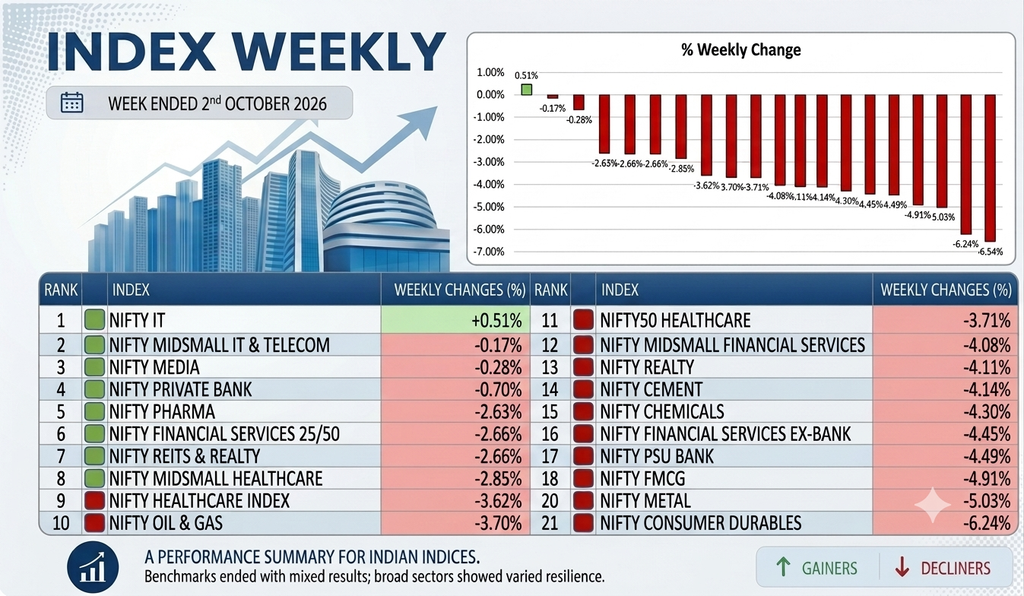
With respect to sectoral performance during the week, selling was broad-based, with the Nifty IT index the only sector to end in the green, gaining 0.51% on the back of a weaker rupee. Losses were relatively contained in the Nifty Midsmall IT & Telecom and Nifty Media indices, which slipped 0.17% and 0.28%, respectively, followed by the Nifty Private Bank index, down 0.70%. Defensive and healthcare-linked segments also came under pressure, with the Nifty Pharma index falling 2.63% and the Nifty Midsmall Healthcare index declining 2.85%, while the Nifty Healthcare and Nifty500 Healthcare indices lost 3.62% and 3.71%, respectively. The Nifty Financial Services 25/50 and Nifty REITs & Realty indices both fell 2.66%, while the Nifty Oil & Gas index declined 3.70%.
Conversely, the steeper declines were led by cyclical, financial and consumption-linked segments. The Nifty Midsmall Financial Services index fell 4.08%, followed by the Nifty Realty and Nifty Cement indices, which declined 4.11% and 4.14%, respectively. The Nifty Chemicals index slipped 4.30%, while the Nifty Financial Services Ex-Bank and Nifty PSU Bank indices fell 4.45% and 4.49%, respectively. The Nifty FMCG index declined 4.91% and the Nifty Metal index lost 5.03%, while the Nifty Consumer Durables index recorded the steepest decline of the week, falling 6.24%. Overall, it was a weak week for sectoral indices, with IT the lone gainer even as consumer durables, metals, FMCG and PSU banks bore the brunt of the selling.
(Source: NSE)
Wrapping Up
Indian equities endured a punishing holiday-shortened week, as rising expectations of an RBI rate hike, crude oil returning to around $100 a barrel, US Treasury yields at multi-decade highs and a weakening rupee combined with persistent foreign selling to push the Sensex to a fresh 52-week low and the Nifty 50 to its eighth straight weekly decline. The selling cut across large-, mid- and small-cap segments, the India VIX rose sharply, and IT was the only sector to close higher. Softer US jobs data, easing Treasury yields and the G7’s planned oil reserve release offer some relief on the global front as markets reopen on Monday. Going forward, the RBI’s policy decision on October 7 is likely to be the key domestic trigger, and investors are likely to closely monitor crude oil prices, developments in the Middle East, US yield movements and Federal Reserve signals, foreign institutional investor flows, the rupee’s trajectory and the start of the September-quarter earnings season for further direction in the market.
