

Indian Equity Markets — Week Ended September 18, 2026
Hello Readers,
Here’s the week in a recap…
Indian equities navigated a volatile week ended September 18, as the US Federal Reserve’s first rate hike since 2023, a fresh governance dispute at Tata Sons and continued uncertainty around crude oil prices kept investors on edge, even as a strong session on Friday helped cushion the market’s broader softness.
Weekly Overview
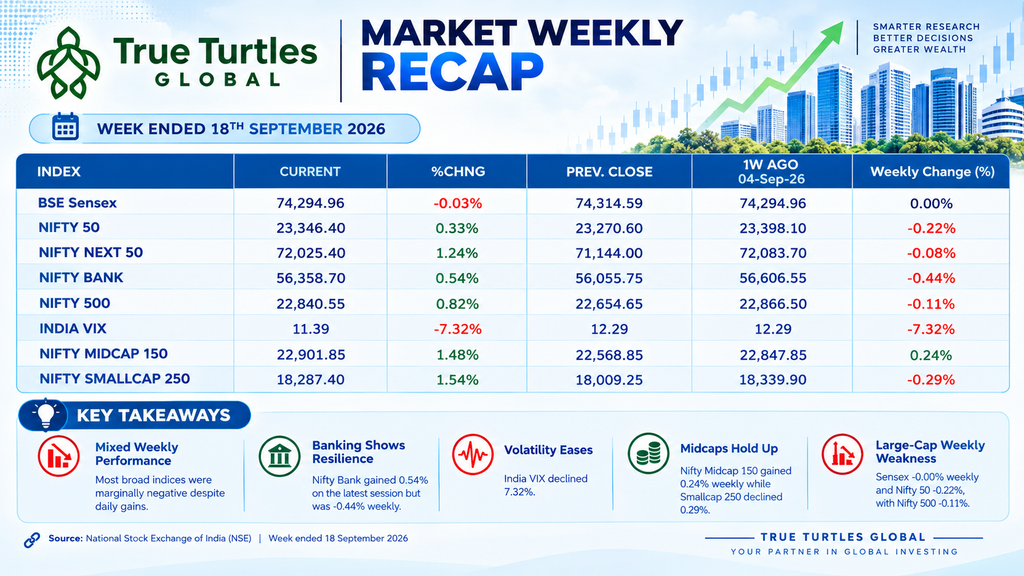
Indian equity markets ended the week on a broadly mixed note, with benchmark indices posting healthy gains in Friday’s session even as the weekly picture remained more measured. The Nifty 50 rose 0.33% on the day to close at 23,346.40, while the BSE Sensex slipped marginally by 0.03% to settle at 74,294.96. On a weekly basis, the Sensex ended little changed versus the previous week’s close, while the Nifty 50 was down 0.22%, as early-week softness offset the strength seen in Friday’s session.
Performance across the broader market was similarly mixed. The Nifty Next 50 rose a sharp 1.24% on the day to close at 72,025.40, though it ended the week marginally lower by 0.08%. The Nifty 500 advanced 0.82% on the day but slipped 0.11% for the week, while the Nifty Bank index, up 0.54% on the day to close at 56,358.70, ended the week down 0.44%. Among the broader indices, the Nifty Midcap 150 was the standout performer, rising 1.48% on the day and ending the week up 0.24% — the only major index to close the week in positive territory — while the Nifty Smallcap 250 surged 1.54% on the day but still finished the week down 0.29%.
Meanwhile, the India VIX fell sharply by 7.32%, both on the day and over the week, to close at 11.39, pointing to a marked easing in market volatility. Overall, the week was characterised by a strong single-day recovery that helped cushion the week’s earlier softness, with resilience in mid-cap stocks, cooling volatility and a broadly mixed-to-modestly-negative trend across the major benchmark indices.
Weekly Performance of Key Indices
Key Market Triggers
● Fed Delivers First Rate Hike Since 2023: The US Federal Reserve raised its benchmark rate by 25 basis points to 3.75%-4.00% on September 16, its first hike since July 2023 and the first policy decision under new Chairman Kevin Warsh. The unanimous decision cited persistently elevated inflation, a resilient labour market and the inflationary risk posed by the ongoing Middle East crisis, lifting the US Dollar Index above 100 and pushing the 10-year Treasury yield closer to 5%.
● Crude Oil Turned Volatile Before Easing Into The Weekend: Brent crude spiked to around $107 a barrel mid-week after Oman postponed GCC-Iran talks on Strait of Hormuz shipping and a tanker was reportedly struck near the Strait, compounded by continued disruption to Saudi Arabia’s East-West pipeline. Prices eased through Thursday and Friday as Saudi Arabia rerouted crude via ship-to-ship transfers, leaving Brent down around 1.2% for the week near $103-104 a barrel.
● Rupee Recovered From Multi-Week Lows: The rupee, which had slipped toward multi-week lows near ₹96 per dollar earlier in the week under pressure from the Fed’s rate hike and elevated crude prices, staged a partial recovery to close near ₹95.7 per dollar by Friday, aided by easing oil prices, likely RBI intervention and expectations of foreign portfolio inflows tied to the NSE’s mega initial public offering.
● Forex Reserves Snap Ten-Week Winning Streak: India’s foreign exchange reserves fell by $4.92 billion to $780.78 billion for the week ended September 11, as per RBI data released during the week, ending a run of ten consecutive weekly gains. The decline came a week after reserves had jumped by a record $44.9 billion to an all-time high of $785.7 billion, led by a fall in foreign currency assets and gold holdings.
● Tata Sons Governance Dispute Rattled Group Stocks: A boardroom rift erupted after Tata Sons’ board voted 4:1 on September 17 to reappoint N. Chandrasekaran as Executive Chairman for another five years, a decision Tata Trusts — led by Noel Tata and holding roughly 66% of Tata Sons — declared invalid for not meeting the affirmative-vote requirements under the company’s Articles of Association. The unresolved dispute weighed on Tata Group counters such as TCS, Titan and Tata Chemicals, dragging on select Sensex heavyweights.
● NSE’s Mega IPO Drained Secondary Market Liquidity: The National Stock Exchange opened its ₹22,562 crore initial public offering — entirely an offer-for-sale — for subscription on September 17, among the largest issues in Indian capital markets history. Strong demand for the offering diverted liquidity away from the secondary market even as it drew robust anchor and institutional interest ahead of its scheduled listing on September 24.
● FIIs Continued To Sell Amid Elevated US Yields: Foreign institutional investors extended their selling streak through the week, spooked by the surge in US Treasury yields and a strengthening dollar following the Fed’s hawkish tilt. Continued domestic institutional buying and bargain-hunting in the broader market helped cushion some of the impact on the headline indices.
Weekly Sectoral Performance
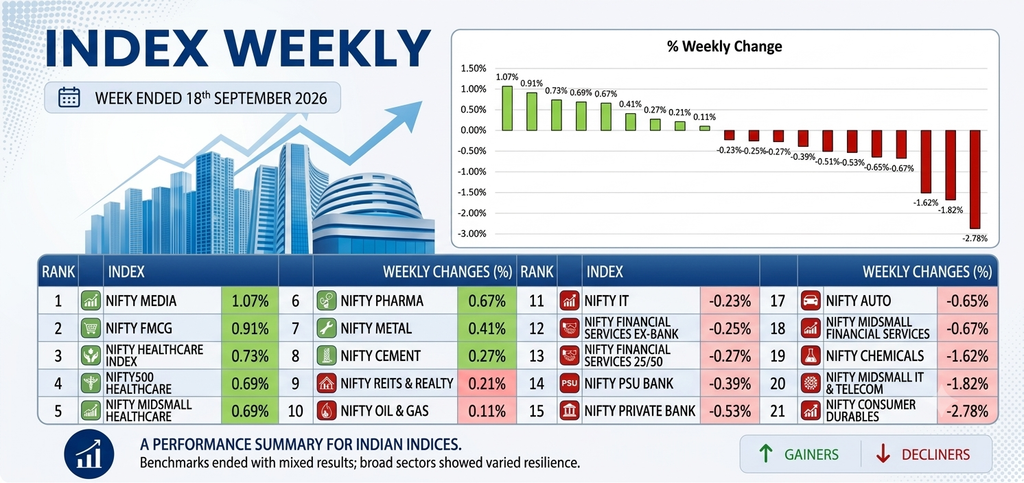
With respect to sectoral performance during the week, gains were broad-based and led by media and consumption-linked segments. The Nifty Media index topped the gainers’ chart with a rise of 1.07%, followed by the Nifty FMCG index, which advanced 0.91%. Healthcare-linked segments extended their recent resilience, with the Nifty Healthcare index adding 0.73%, while the Nifty500 Healthcare and Nifty Midsmall Healthcare indices both gained 0.69% each. The Nifty Pharma index rose 0.67%, followed by the Nifty Metal index, up 0.41%. The Nifty Cement, Nifty REITs & Realty and Nifty Oil & Gas indices rounded out the week’s gainers with more modest advances of 0.27%, 0.21% and 0.11%, respectively.
Conversely, the Nifty IT index led the week’s laggards with a decline of 0.23%, followed by the Nifty Financial Services Ex-Bank and Nifty Financial Services 25/50 indices, which slipped 0.25% and 0.27%, respectively. Banking-linked indices were also under modest pressure, with the Nifty PSU Bank down 0.39% and the Nifty Private Bank declining 0.53%. The Nifty Auto and Nifty Midsmall Financial Services indices fell 0.65% and 0.67%, respectively, while the Nifty Chemicals index declined a sharper 1.62%. The Nifty Midsmall IT & Telecom index was among the weakest performers, down 1.82%, while the Nifty Consumer Durables index recorded the steepest decline of the week, falling 2.78%, rounding out the week’s sectoral decliners. Overall, it was a comparatively resilient week for sectoral indices, with media, FMCG and healthcare-linked segments leading the gains even as IT, auto, chemicals and consumer durables bore the brunt of the selling.
(Source: NSE)
Wrapping Up
Indian equities navigated a turbulent week, as the Federal Reserve’s first interest rate hike since 2023, continued volatility in crude oil prices amid the ongoing Middle East crisis and a fresh governance dispute at Tata Sons weighed on investor sentiment. The Nifty 50 and Sensex ended the week largely range-bound, even as a sharp easing in the India VIX pointed to calmer nerves by Friday. Resilience in mid-cap stocks, a partial recovery in the rupee and easing crude prices through the back half of the week provided a degree of cushion against the broader uncertainty. Markets are likely to remain sensitive to further developments around the Tata Sons leadership dispute, the listing of the NSE’s mega initial public offering and the situation around the Strait of Hormuz. Going forward, investors are likely to closely monitor crude oil price movements, developments in the Middle East, the Federal Reserve’s next policy signals, foreign institutional investor flows and the rupee’s trajectory for further direction in the market.
