

Hello Readers,
Here’s the week in a recap…
Indian equities remained under pressure during the week ended September 11, with the benchmark indices extending their losing streak amid a sharp surge in crude oil prices and heightened geopolitical tensions in the Middle East.
Weekly Overview
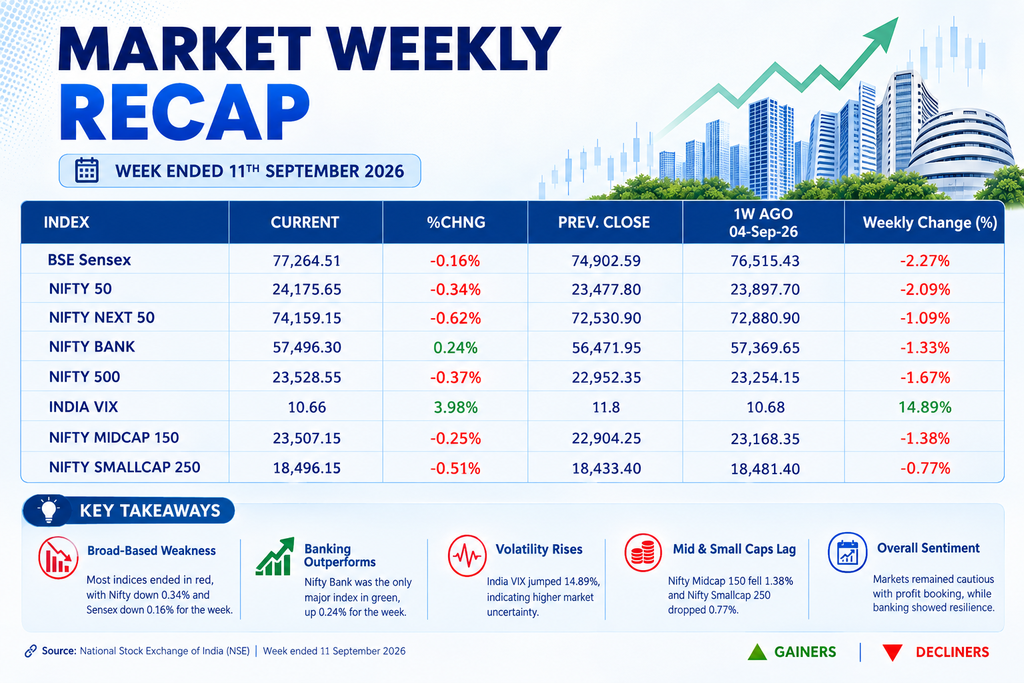
Indian equity markets concluded the week on a negative note, with both benchmark indices registering sharp losses. The Nifty 50 declined 0.34% on the day to close at 24,175.65, while the BSE Sensex fell 0.16% to settle at 77,264.51. On a weekly basis, however, the decline was far steeper, with the Sensex down 2.27% and the Nifty 50 down 2.09% versus the previous week’s close, as the indices came under sustained selling pressure through the week.
Performance across the broader market was similarly weak, with the Nifty 500 declining 1.67% and the Nifty Midcap 150 falling 1.38% over the week. The Nifty Smallcap 250 held up comparatively better but still slipped 0.77%, while the Nifty Next 50 declined 1.09%. Banking stocks were a rare bright spot on the day, with the Nifty Bank index gaining 0.24% to close at 57,496.30, even as it ended the week down 1.33% — making it the most resilient of the major indices.
Meanwhile, the India VIX rose 3.98% on the day to close at 10.66, and was up sharply by 14.89% over the week, pointing to a marked rise in market uncertainty. Overall, the week was marked by broad-based weakness across most segments, with sustained profit-booking, resilience in banking stocks and continued caution among investors amid volatile global cues.
Weekly Performance of Key Indices
Key Market Triggers
● Crude Oil Prices Surged On Middle East Tensions: Brent crude climbed sharply through the week, moving well above $100 a barrel and briefly approaching $110 as attacks on tankers in the Strait of Hormuz intensified and Iran-aligned forces threatened shipping in the Red Sea. The spike revived concerns for India, given its heavy dependence on crude imports and the implications for inflation, the current account and corporate margins.
● Rupee Remained Under Pressure Near ₹95.6/$: The Indian rupee slipped for a third straight session to around ₹95.6 per dollar by Friday, as surging crude prices and elevated US Treasury yields intensified pressure on the currency. The Reserve Bank of India continued to intervene to temper the decline, though traders noted the central bank appeared increasingly reluctant to defend the currency aggressively as external pressures mounted.
● Forex Reserves Hit Record High: India’s foreign-exchange reserves jumped by a record $44.9 billion and reached an all-time high of $785.7 billion in the week to September 4, marking the tenth straight week of gains. The surge was driven by strong dollar inflows under the RBI’s diaspora deposit and hedging schemes, further strengthening the central bank’s ability to manage external and currency-related risks.
● Global Bond Yields Weighed On Sentiment: US Treasury yields climbed through the week, with the 10-year yield nearing 5% after stronger-than-expected producer price data lifted expectations of a Federal Reserve rate hike. Higher yields strengthened the dollar and reduced the relative attractiveness of Indian equities, particularly for foreign investors.
● Fed Policy Expectations Remained In Focus: Investors stayed on edge ahead of the Federal Reserve’s September 15-16 meeting, the first under new Fed Chair Kevin Warsh, with markets pricing in a meaningful probability of a rate hike following a run of hotter-than-expected US inflation and jobs data. The uncertainty kept global risk assets, including Indian equities, on the back foot through the week.
● IT Stocks Led The Selloff On Fed Rate-Hike Bets: Indian IT stocks were among the biggest laggards through the week after stronger-than-expected US employment and inflation data revived expectations of tighter Fed policy, raising concerns over discretionary technology spending by US clients. The Nifty IT index shed close to 6% over the week, with Infosys, HCL Technologies, Wipro and Tech Mahindra among the top decliners.
Weekly Sectoral Performance
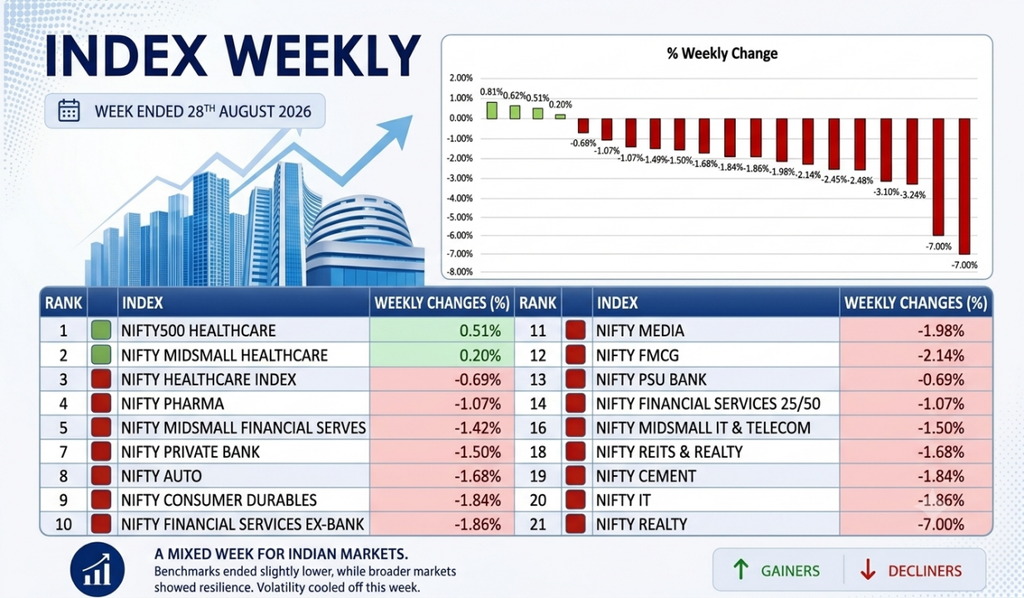
With respect to sectoral performance during the week, gains were narrow and largely confined to healthcare-linked segments. The Nifty 500 Healthcare index led with a modest rise of 0.51%, followed by the Nifty Midsmall Healthcare index, which advanced 0.20%. Nearly every other sectoral index ended the week in the red, reflecting broad-based weakness across the market. The Nifty Healthcare index and Nifty PSU Bank both slipped 0.69%, while the Nifty Pharma and Nifty Financial Services 25/50 indices declined 1.07% each.
Conversely, the Nifty Realty index recorded the steepest decline, plunging 7.00% during the week, underscoring pronounced weakness in rate-sensitive sectors. This was followed by declines in the Nifty Midsmall Financial Services (-1.42%), Nifty Private Bank and Nifty Midsmall IT & Telecom (-1.50% each), Nifty Auto and Nifty REITs & Realty (-1.68% each), and Nifty Consumer Durables and Nifty Cement (-1.84% each). The Nifty Financial Services Ex-Bank and Nifty IT indices both fell 1.86%, while the Nifty Media index declined 1.98%. The weakness observed in The Nifty FMCG index rounded out the week’s decliners, falling 2.14%, weighed down by broad profit-booking and cautious consumer-demand sentiment. Overall, it was a broadly mixed-to-weak week for sectoral indices, with only healthcare-linked pockets offering relative resilience while rate-sensitive and export-oriented sectors bore the brunt of the selling.
(Source: NSE)
Wrapping Up
Indian equities remained under considerable pressure over the course of the week as a sharp surge in crude oil prices amid escalating Middle East tensions, a weakening rupee and elevated US bond yields ahead of the Federal Reserve’s policy meeting weighed heavily on investor sentiment. The Nifty 50 and Sensex extended their losing streak, while a sharp rise in the India VIX underscored the cautious mood among market participants. Nonetheless, resilience in banking stocks, a record surge in India’s forex reserves and continued domestic institutional buying provided a degree of cushion against the broader weakness. The rupee is likely to remain sensitive to further moves in crude prices and developments around the Strait of Hormuz. Going forward, investors are likely to closely monitor crude oil price movements, developments in the Middle East, the outcome of the US Federal Reserve’s policy meeting, foreign institutional investor flows and the rupee’s trajectory for further direction in the market.
