

Hello Readers,
Here’s the week in a recap…
Indian markets started August on a positive note, with Nifty 50 and Sensex gaining 0.77% and 0.52%, respectively, despite a weak Friday finish. FII buying, a stable rupee, and the RBI’s policy pause supported sentiment, while PSU Banks, Metals and Auto led sectoral gains.
Weekly Overview
Indian equity markets started the month of August on a positive note with most of the benchmark indices posting positive returns over the past week. While crude prices remained volatile, triggering market movement during the week, easing prices boosted the sentiments of investors across the globe as well as in India.
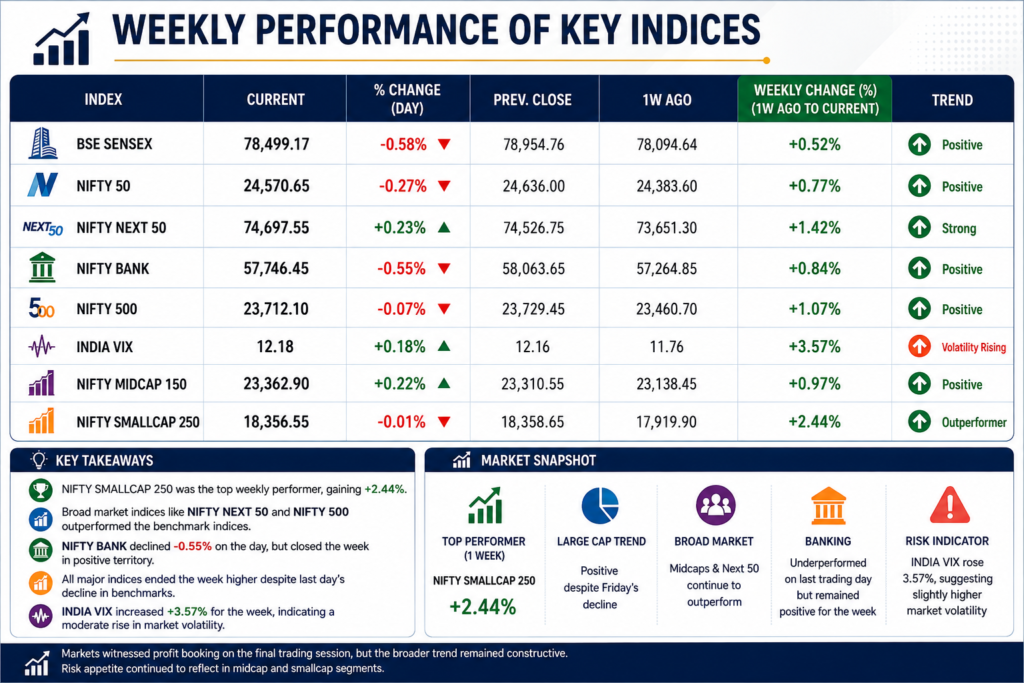
Having said that, both equity benchmark indices, Nifty 50 and BSE Sensex, ended the week on Friday, 7 August, in the red. The Nifty 50 lost around 0.27% on Friday, but gained over 0.77% through the week. Similarly, BSE Sensex gained around 0.52% through the week, but ended 0.58% down on Friday.
The broader market maintained a positive trend during the week, with the Nifty 500 gaining 1.07% to close at 23,712.10. The Nifty Midcap 150 rose 0.97%, while the Nifty Smallcap 250 outperformed with a 2.44% gain, signalling healthy participation beyond large-cap stocks.
Banking stocks also ended the week higher, with the Nifty Bank advancing 0.84% to 57,746.45, supported by continued interest in financial stocks. However, the India VIX climbed 3.57% to 12.18, indicating a modest rise in market volatility.
Weekly Performance of Key Indices
(Source: NSE, BSE)
Key Market Triggers
- Crude Price Volatility: Crude oil prices remained volatile during the week, with geopolitical developments around the Strait of Hormuz continuing to influence sentiments. Brent Crude fell sharply at the beginning of the week on Monday to $83.55 per barrel but then again surged owing to shipping disruptions, and finally settled at $82.7 per barrel on Friday.
- Rupee Strengthened Further: The Indian Rupee strengthened during the week as well, after appreciating significantly last week. During the week, it appreciated around 0.2% to Rs 95.21 per US dollar. Even though crude prices were volatile, Indian currency remained stable mostly during the week, supported by RBI’s intervention and solid foreign-currency inflow.
- FIIs Bought Equities worth $1.3 Billion: Talking about foreign-currency inflow, FIIs bought Indian equities worth more than $1.3 billion during the week ended on 7 August, 2026. This is the third week in a row they remained net buyer, and their net purchases are increasing every week.
- Q1 FY27 Earnings Reactions: While benchmark indices ended in the green, the gains were marginal and stock-specific movement ruled the market last week as well. Q1 earnings have been a primary reason for the same, with companies like SBI, Bharti Airtel, LIC announcing their results this week.
- RBI Keeps Repo Rate Unchanged: The RBI kept the repo rate unchanged at 5.25% on August 5, in line with expectations. The central bank maintained a cautious approach amid elevated oil prices and geopolitical uncertainty, while signalling that broader inflation pressures remain contained. It revised its FY27 inflation forecast down to 5% and raised its growth forecast to 6.7%, providing some comfort to equity investors.
Weekly Sectoral Performance
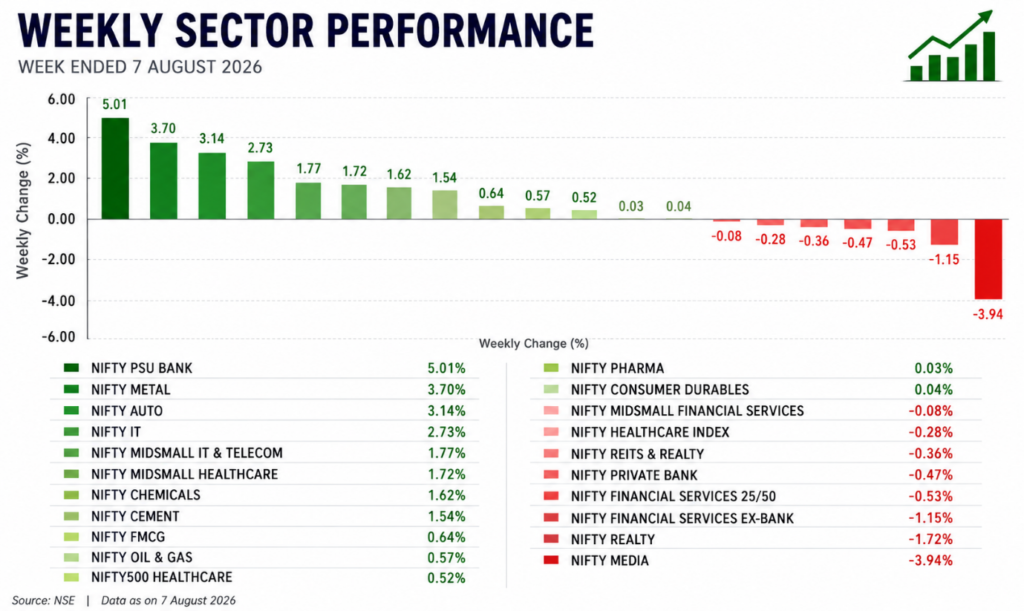
Coming to sectoral performance during the week, Nifty PSU banks led with a 5.01% surge, followed by Nifty Metal gaining 3.7% during the week, and Nifty Auto gaining 3.14%.
On the flip side, Nifty Media declined close to 4%, followed by Nifty Realty losing 1.72%, and Nifty Financial Services Ex-Bank index losing 1.15% during the week.
Wrapping Up
Indian markets began August on a positive note, with benchmark indices extending their gains despite a weak finish on Friday. Easing crude prices, a stronger rupee, continued FII buying and the RBI’s unchanged policy stance supported investor sentiment during the week. However, geopolitical risks and stock-specific reactions to Q1 earnings kept volatility elevated. Going ahead, investors will closely track the remaining Q1 results, crude oil movements, global cues and foreign fund flows for further direction.
