

Hello Readers,
Here’s the week in a recap…
Indian markets rebounded sharply during the week, recovering from the previous week’s losses as easing crude oil prices, a stronger rupee, continued FII buying, and encouraging corporate earnings boosted investor sentiment. Broad-based buying across large-, mid-, and small-cap stocks, coupled with lower market volatility, reflected improving confidence despite lingering global uncertainties.
Weekly Overview
The domestic market in India ended the month of July on a positive note after a month-long period of volatility. Recovering from the previous week’s sharp fall, this week, the market sentiment was mostly positive, driven by crude price correction, a firmer rupee, mixed Q1 earnings, and other factors.
Indian benchmark indices ended the week on a strong note as well. The Nifty 50 climbed 2.59% to close at 24,383.60, while the BSE Sensex gained 2.68% to settle at 78,094.64. The gains reflected broad-based buying across sectors, with investors taking comfort from easing macroeconomic concerns and a healthy start to the June quarter earnings season.
The positive momentum was mirrored across the broader markets, highlighting improving market breadth. The Nifty Next 50 advanced 2.63%, while the Nifty Midcap 150 and Nifty Smallcap 250 rose 2% and 1.81%, respectively, as investors increased exposure beyond large-cap stocks. Banking shares also contributed to the rally, with the Nifty Bank gaining 1.01% during the week.
Meanwhile, the India VIX declined 16.18%, indicating easing volatility and growing confidence among market participants.
Weekly Performance of Key Indices
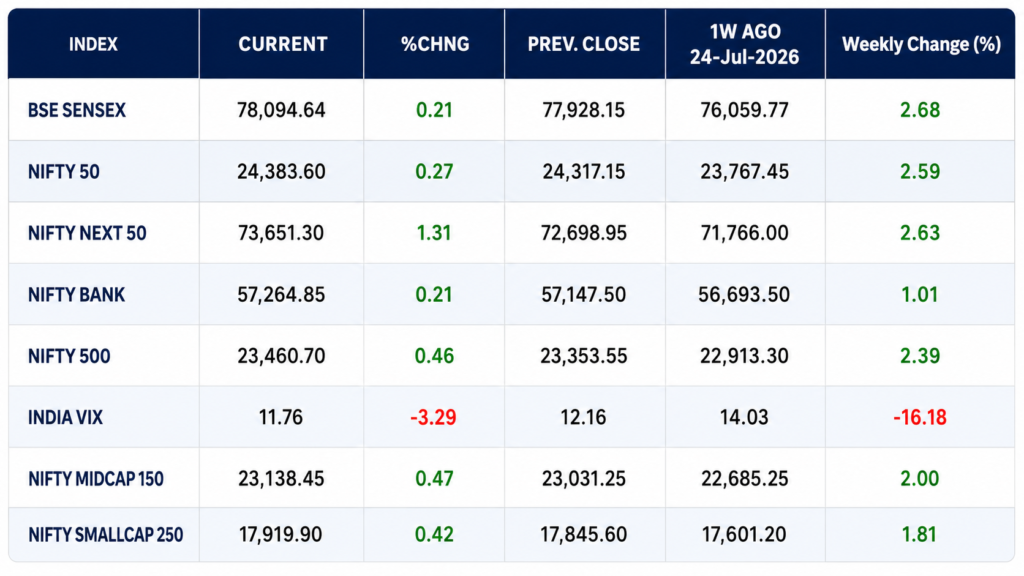
(Source: NSE, BSE)
Key Market Triggers
- Crude Price Correction: Crude oil prices witnessed a sharp correction during the week as concerns over supply disruptions eased and investors booked profits after the recent rally. Brent crude declined from around US$98.87 per barrel at the end of the previous week to about US$90.12 per barrel, while WTI crude fell from around US$90.59 per barrel to US$84.67 per barrel by Friday. The decline was driven by expectations of improved global supply, easing concerns over disruptions in key shipping routes, and weaker demand sentiment, although ongoing geopolitical tensions in the Middle East continued to keep prices volatile throughout the week.
- Rupee’s Strongest Weekly Gains Since March’26: The Indian Rupee strengthened during the week, appreciating around 1%, to end at around ₹95.38 per US dollar, aided by RBI’s intervention.
- FIIs Remained Net Buyers: Talking about FIIs, they remained net buyers of Indian equities during the week ended on 31 July. They bought domestic equities worth around $500 million, up from the previous week’s $263 million of net purchase.
- Q1 FY27 Earnings Reactions: Stock-specific moves continued as major corporate entities announced quarterly results. Maruti Suzuki and ITC both announced results this week and posted sharp drops in profits, which hindered market sentiment to some extent.
Weekly Sectoral Performance
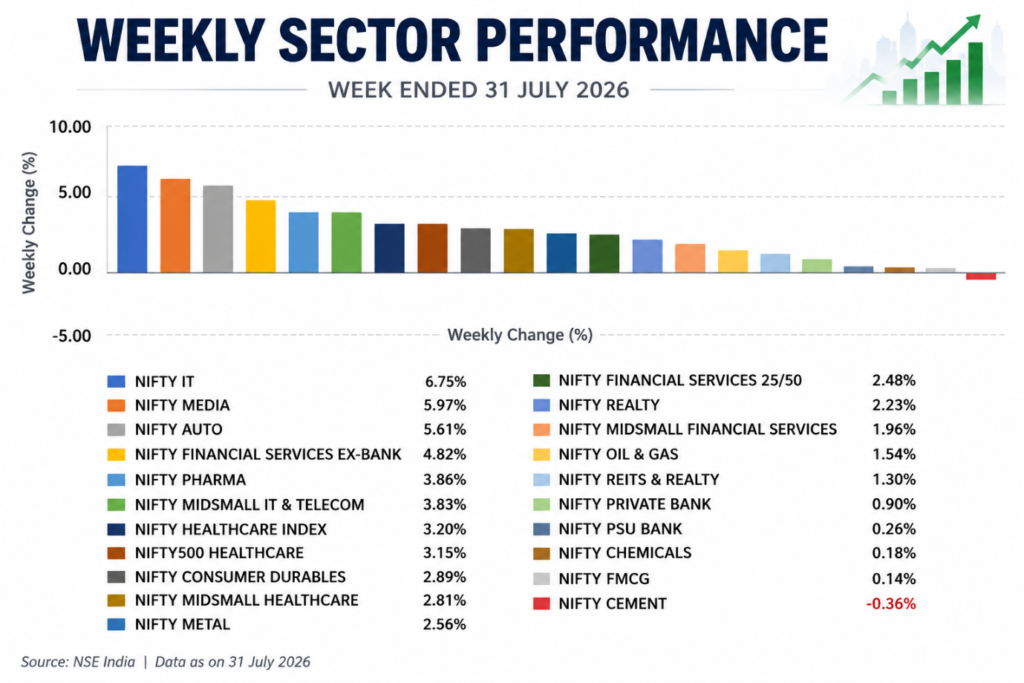
The Nifty IT index led the gains, rising 6.75% on the back of strong Q1 earnings and positive management commentary from major technology companies. Nifty Media advanced 5.97% amid earnings optimism and an improved advertising outlook, while Nifty Auto gained 5.61%, supported by healthy monthly sales, easing crude oil prices, and expectations of strong festive demand.
The Nifty Cement index was the weakest performer, slipping 0.36% due to profit booking and cost concerns. Nifty FMCG and Nifty Chemicals underperformed with gains of just 0.14% and 0.18%, respectively, as investors preferred cyclical sectors over defensives while weak export demand continued to weigh on chemical stocks.
Wrapping Up
The domestic equity market closed the week on a stronger footing, supported by easing macroeconomic concerns and broad-based participation across sectors. While lower crude oil prices, a firmer rupee, and sustained foreign investor inflows improved market sentiment, stock-specific reactions to the ongoing Q1 earnings season continued to drive individual counters. Although geopolitical developments remain a key source of uncertainty, the sharp decline in market volatility suggests investors are becoming more confident. Looking ahead, the remaining Q1 earnings announcements, crude oil price movements, the upcoming meeting of the RBI from August 3 to August 5, and foreign fund flows will be the key factors influencing market direction.
