

Hello Readers,
One of the biggest IPOs of 2026 is finally here.
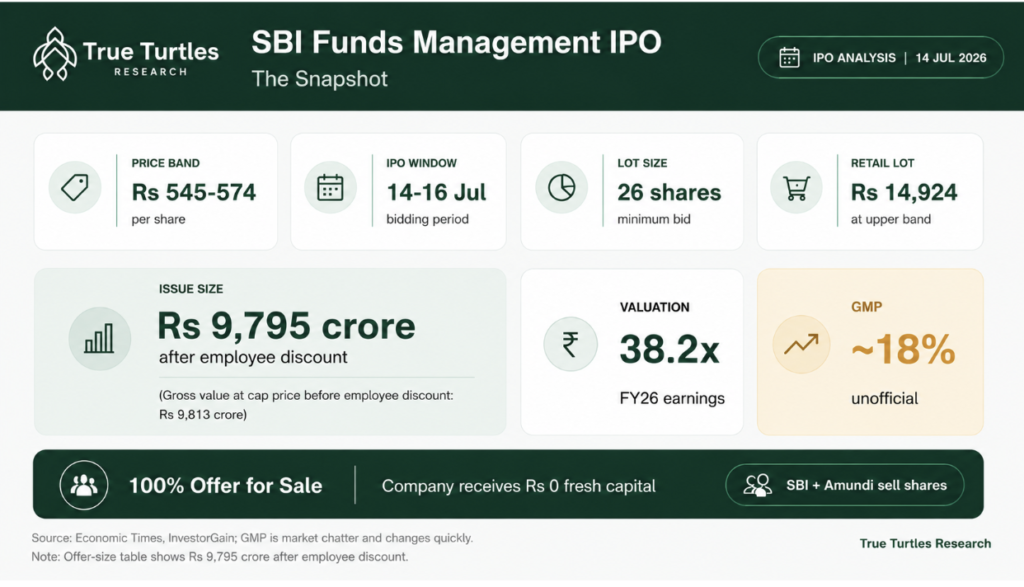
SBI Funds Management, the company behind SBI Mutual Fund, is coming out with its IPO from 14 July to 16 July 2026. The price band is fixed at Rs 545 to Rs 574 per share, and the current grey market premium is indicating a possible listing gain of around 18%.
At first glance, the story looks simple.
- India’s largest mutual fund house
- Backed by SBI
- Strong profits
- Strong brand recall
- Positive GMP
But as always, the real investing question is not just whether the IPO is popular. The question is whether the business quality, valuation, and risks leave enough room for investors after listing.
The Basic IPO Details
The IPO size was earlier expected to be around Rs 11,693 crore. However, after pre-IPO secondary transfers worth about Rs 1,880 crore to institutional and marquee investors, the gross offer value comes to around Rs 9,813 crore at the cap price before employee discount. After accounting for the employee discount, the Addendum shows the offer size at around Rs 9,795 crore.
This is important for two reasons.
- Large investors were willing to buy shares before the IPO at the upper price band of Rs 574. That gives some comfort around demand.
- The reduced public offer means fewer shares are now available in the IPO. If demand remains strong, this could support subscription numbers and listing sentiment.
However, investors should also remember one key point.
This IPO Is Fully an Offer for Sale
SBI Funds Management is not raising fresh money through this IPO. The entire issue is an Offer for Sale by existing shareholders, mainly State Bank of India and Amundi India Holding.
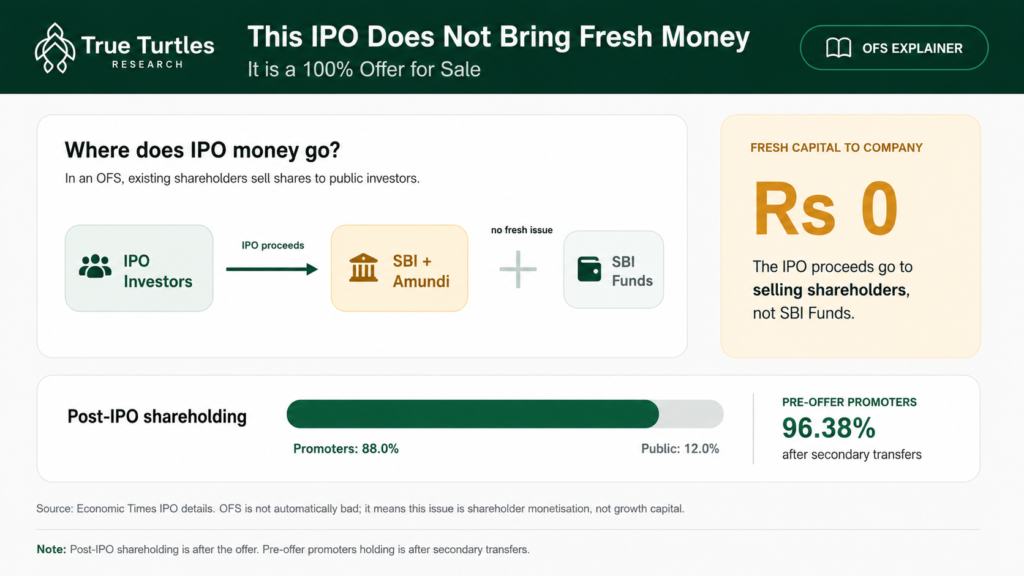
This means the IPO proceeds will go to the selling shareholders, not to the company. This does not make the IPO bad. Many mature, profitable businesses list through an OFS.
But it does tell us that this IPO is more about promoter monetisation than business expansion. SBI and Amundi are unlocking value from a business built over decades.
Why SBI Funds Is a Strong Business
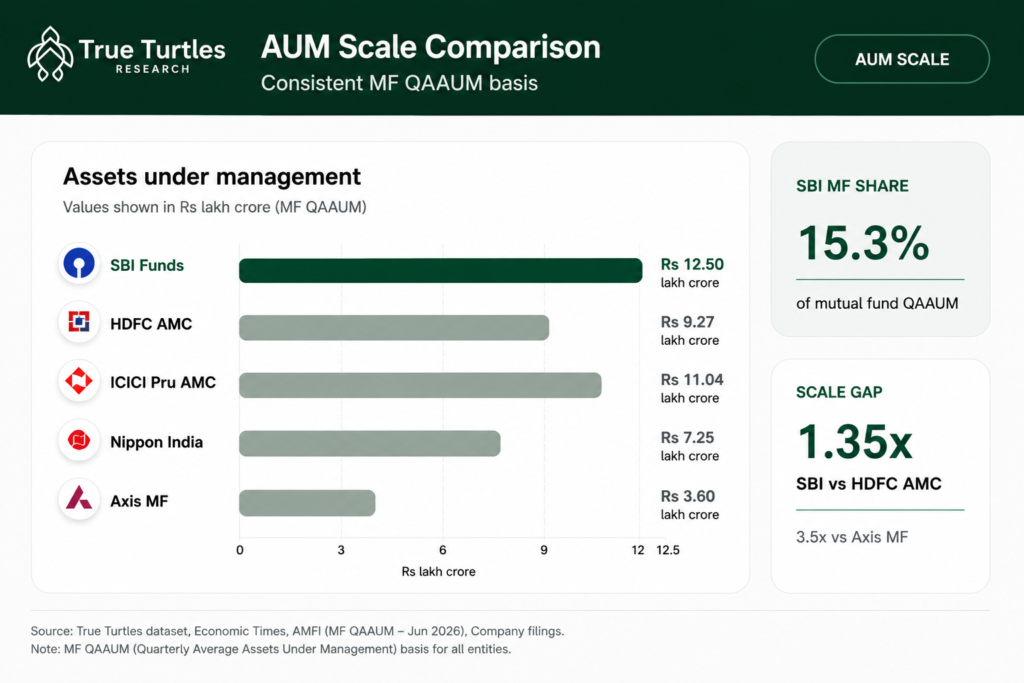
SBI Funds Management is India’s largest asset management company. As of March 2026, it had around Rs 12.5 lakh crore of mutual fund quarterly average AUM and about 15.3% market share. That is a massive scale advantage.
The business also benefits from:
- SBI’s banking network
- strong brand trust
- wide distributor reach
- a large SIP investor base
- Amundi’s global asset management experience
The financials are also impressive. For FY26, the company reported revenue from operations of Rs 4,389 crore and profit after tax of Rs 3,067 crore. Return on equity stood at 43.0%, which shows how profitable and asset-light the AMC business can be when scale is high.
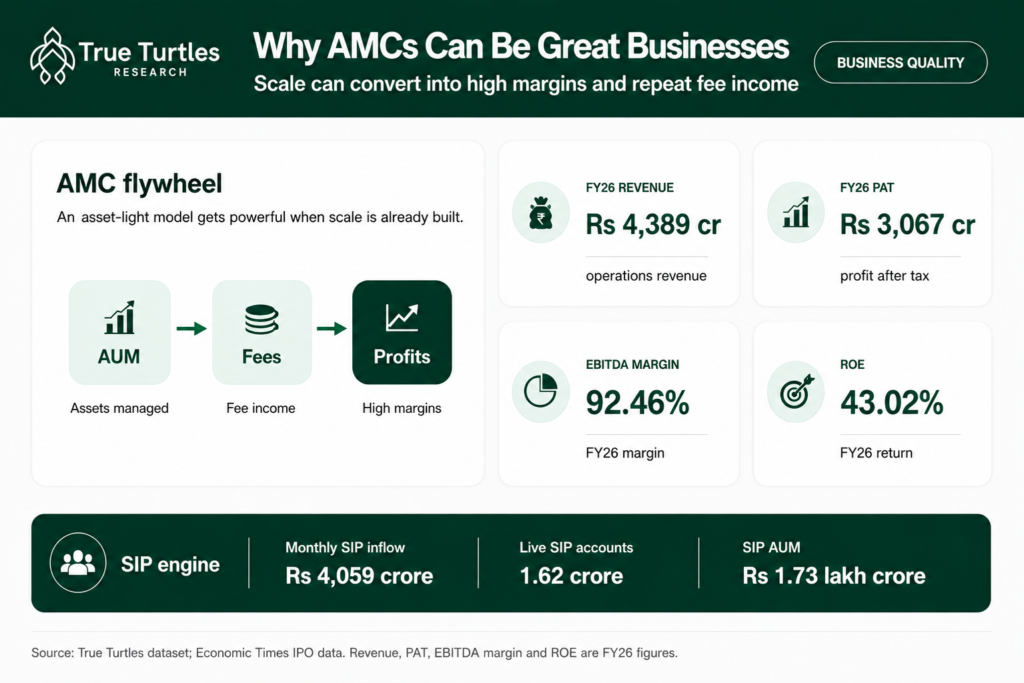
This is the beauty of an AMC business. Once the platform is built, incremental AUM can flow through at high margins. The company earns fees on assets managed, and as India’s financialisation story grows, large AMCs can benefit from long-term SIP and mutual fund penetration.
The Industry Tailwind Is Real
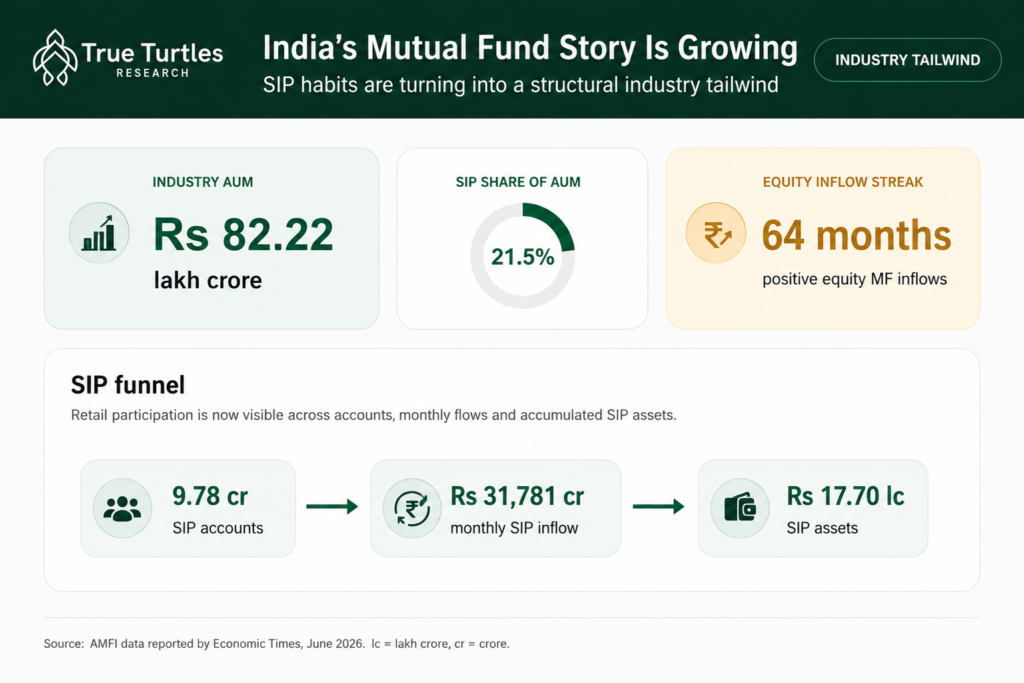
India’s mutual fund industry has been growing rapidly. In June 2026, industry AUM touched around Rs 82.22 lakh crore. SIP contributions reached Rs 31,781 crore, while SIP assets stood at Rs 17.70 lakh crore, forming more than 21% of total industry AUM.
This shows that mutual funds are no longer just a metro investor product. SIPs have become a structural habit for Indian households. For an AMC like SBI Funds, this is a powerful long-term tailwind.
But There Are Risks Too
The AMC business is good, but it is not risk-free.
- Revenue is linked to market levels. When markets fall, AUM falls, and fee income can come under pressure.
- Expense ratios are under regulatory watch. Any reduction in allowed fees can directly impact profitability.
- Digital-first platforms like Zerodha and Groww are changing distribution through direct plans, app-based investing, and low-cost products.
- SBI Funds has a large passive and ETF base. Passive products bring huge scale, but they usually earn lower fees than active equity funds.
So investors should not judge the business only by AUM size. The fee mix matters.
Valuation and GMP
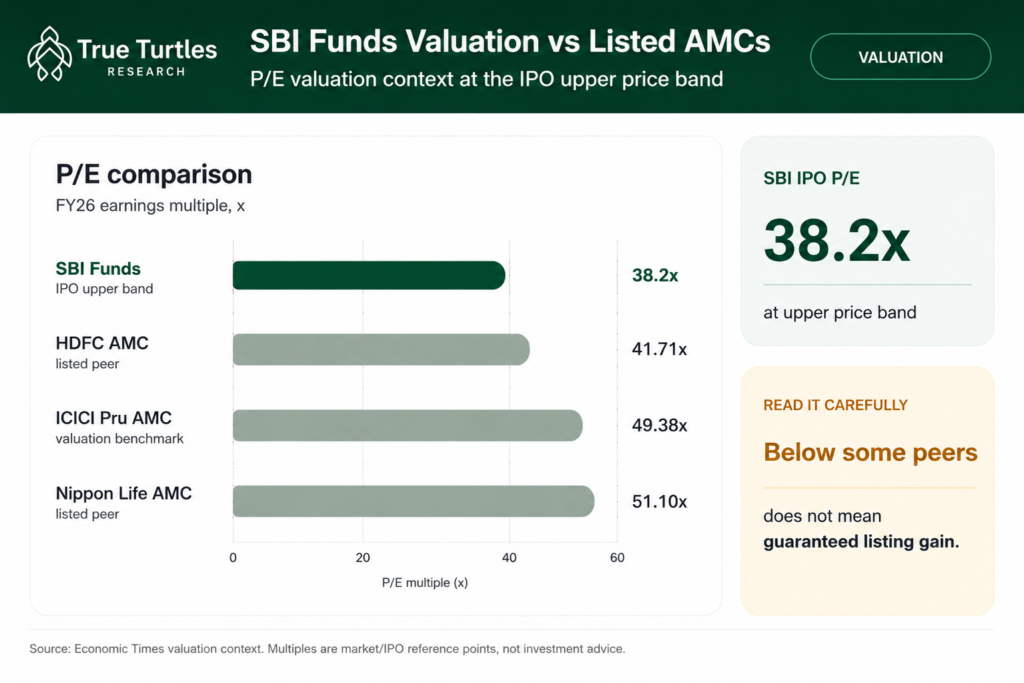
At the upper price band of Rs 574, SBI Funds Management is valued at roughly 38.2 times FY26 earnings. This is slightly below some listed AMC peers, which gives the IPO some valuation comfort.
The GMP of around 18% shows positive demand in the grey market. But GMP should never be treated as a guarantee. Listing performance will depend on final subscription, market mood, institutional demand, and how investors compare SBI Funds with other listed AMC stocks.
Final View

SBI Funds Management is a high-quality, high-margin, market-leading AMC business. The long-term story is supported by India’s mutual fund penetration, SIP growth, SBI’s distribution strength, and the shift from physical savings to financial assets.
But investors should avoid looking at this IPO only through the lens of GMP. The real opportunity is not just a listing pop. It is whether SBI Funds can continue growing profitably while defending market share in a more competitive, fee-sensitive, digital-first mutual fund industry.
For short-term investors, GMP and subscription demand will matter.
For long-term investors, the bigger question is simple:
Can India’s largest AMC convert its scale into sustained earnings growth without losing margins?
That will decide whether this IPO becomes more than just another big listing.
