

Hello Readers,
Here’s the week in a recap…
Indian equities remained under pressure during the week ended Aug. 21, with benchmark indices extending their recent decline amid higher crude oil prices and concerns over global bond yields.
Weekly Overview
Indian equity markets ended the week on a negative note, with both benchmark indices declining for the second consecutive week. The Nifty 50 fell 0.47% to close at 24,252, while the BSE Sensex declined 0.60% to settle at 77,540.83. However, both indices ended Friday on a positive note, with the Nifty 50 gaining 0.08%, while the Sensex remained almost flat.
The broader market remained mixed during the week, with the Nifty 500 declining 0.27% and the Nifty Midcap 150 slipping marginally by 0.05%. On the other hand, the Nifty Smallcap 250 gained 0.74%, indicating relatively stronger participation in the smaller-cap segment. Banking stocks also remained resilient, with the Nifty Bank gaining 0.47% during the week.
Meanwhile, the India VIX declined 0.97% to 11.20, indicating that overall volatility remained relatively contained despite continued concerns around crude prices and global cues.
Weekly Performance of Key Indices
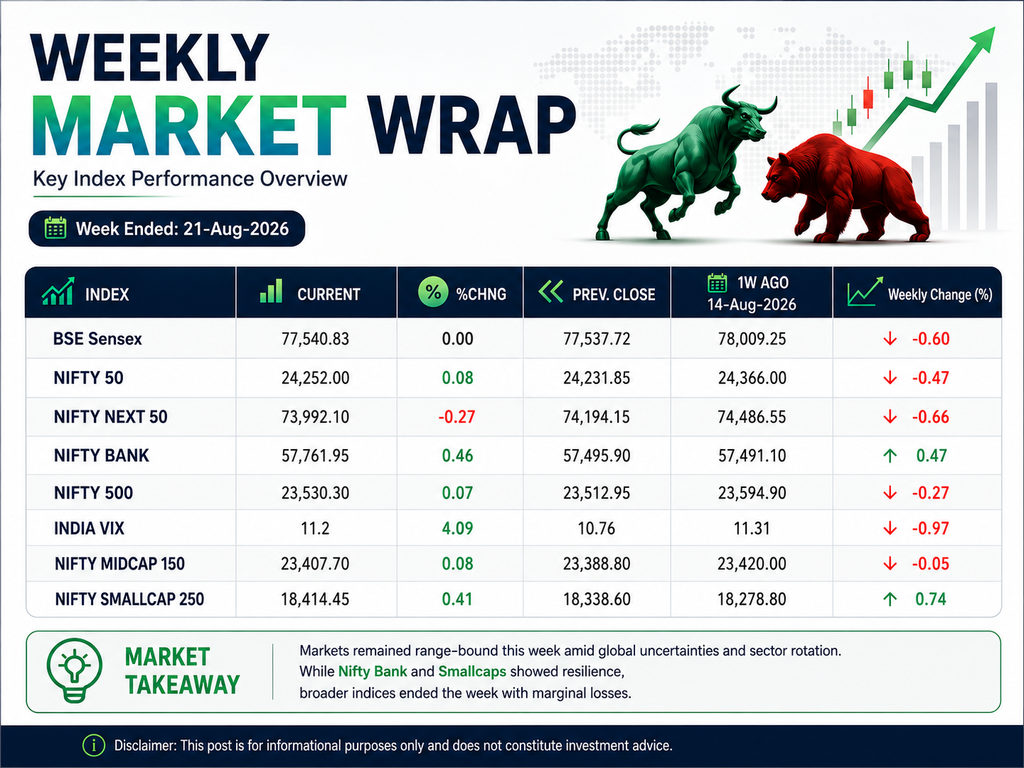
(Source: NSE, BSE)
Key Market Triggers
- Crude Oil Prices Surged: Crude oil remained one of the biggest triggers for Indian markets during the week. Brent crude rose 6.39% during the week to settle at $94.39 per barrel, while WTI crude gained 5.66% to end at $87.06 per barrel on Friday. The rise was driven by renewed concerns over supply disruptions amid the US-Iran conflict, including threats of sanctions on countries trading with Iran. Disruptions to shipping through the Strait of Hormuz also remained a key concern for global oil markets.
- Rupee Remained Under Pressure: The Indian rupee weakened during the week as rising crude prices and continued dollar demand from importers weighed on the currency. The rupee touched a three-week low during the week, with RBI intervention helping limit further depreciation as it approached the Rs 96 per dollar level.
- FIIs Remained Net Buyers: Foreign investors doubled their purchase of domestic equities during the week as they bought equities worth $724 million (net).
- RBI Minutes Remained In Focus: The RBI’s August policy meeting minutes released during the week indicated that policymakers remained cautious about inflation risks. While the repo rate was unchanged at 5.25%, the minutes suggested that the central bank could consider rate hikes if higher oil, food and input costs begin to create broader inflationary pressure.
- Global Bond Yields Weighed On Sentiment: Rising global bond yields also remained a concern for investors during the week. Higher yields can make emerging-market assets relatively less attractive and increase concerns around global financial conditions. The pressure was particularly visible in IT stocks, which remained among the weakest sectoral performers. The trend, however, reversed towards the end of the week after the US Treasury announced a bond-buyback programme.
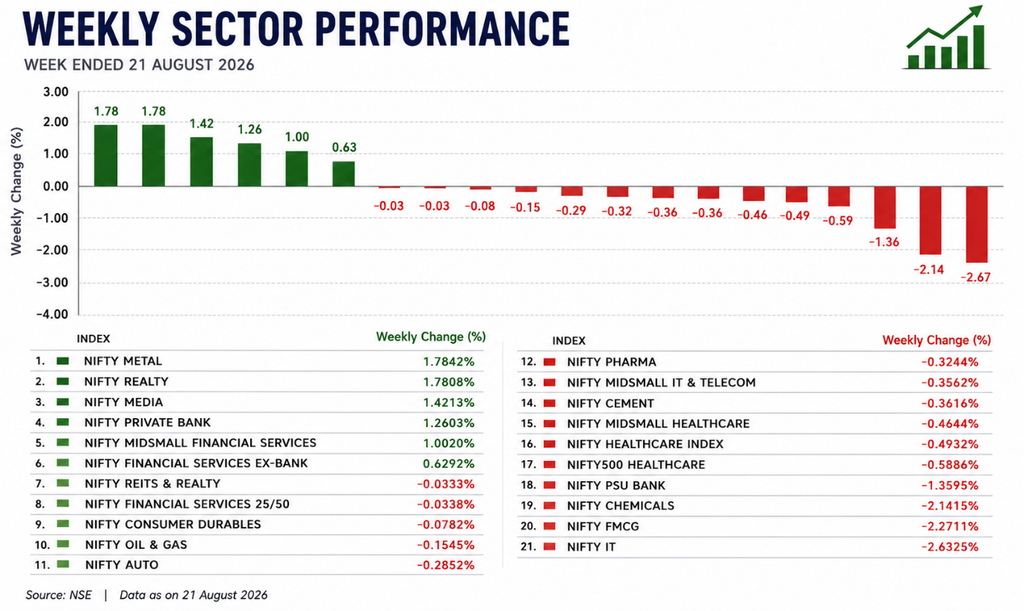
Weekly Sectoral Performance
Coming to sectoral performance during the week, Nifty Metal led the gains with a 1.78% rise, followed closely by Nifty Realty, which gained 1.78%. Nifty Media also performed well, advancing 1.42% during the week. Private banking stocks remained resilient as well, with Nifty Private Bank gaining 1.26%.
On the flip side, Nifty IT declined the most, losing 2.63% during the week, followed by Nifty FMCG, which fell 2.27%, and Nifty Chemicals, which declined 2.14%. The weakness in IT was in line with broader concerns over global yields and US inflation, while FMCG and chemical stocks remained under pressure amid cautious market sentiment.
Wrapping Up
Indian equities remained under pressure this week as rising crude oil prices, geopolitical uncertainty and global bond yields weighed on investor sentiment. However, strong participation from domestic institutions as well as foreign institutions and resilience in banking and select broader-market segments provided some cushion to the market. The rupee also remained under pressure as higher oil prices increased concerns over the country’s external position. Going ahead, investors will closely track crude oil movements, geopolitical developments, FII flows, global rate cues, and domestic economic data for further market direction.
