

Hello Readers,
Here’s the week in a recap…
While strong Q1 earnings and continued domestic institutional buying provided some support, investors remained cautious amid concerns over oil prices, inflation, and global rate signals.
Weekly Overview
Indian equity markets ended the week on Friday, 14 August, in the red as rising crude prices and ongoing geopolitical tensions in the Middle East weighed on investor sentiment again. The Nifty 50 declined 0.83% during the week to close at 24,366, while the BSE Sensex lost 0.62% to settle at 78,009.25.
The broader market also remained mixed during the week. The Nifty 500 declined 0.49%, while the Nifty Smallcap 250 lost 0.42%. However, the Nifty Midcap 150 gained 0.24%, indicating some resilience in the mid-cap segment. Banking stocks also remained under pressure, with the Nifty Bank declining 0.44% during the week.
Meanwhile, the India VIX declined 6.91% to 11.32, indicating that overall market volatility remained subdued despite the weakness in benchmark indices.
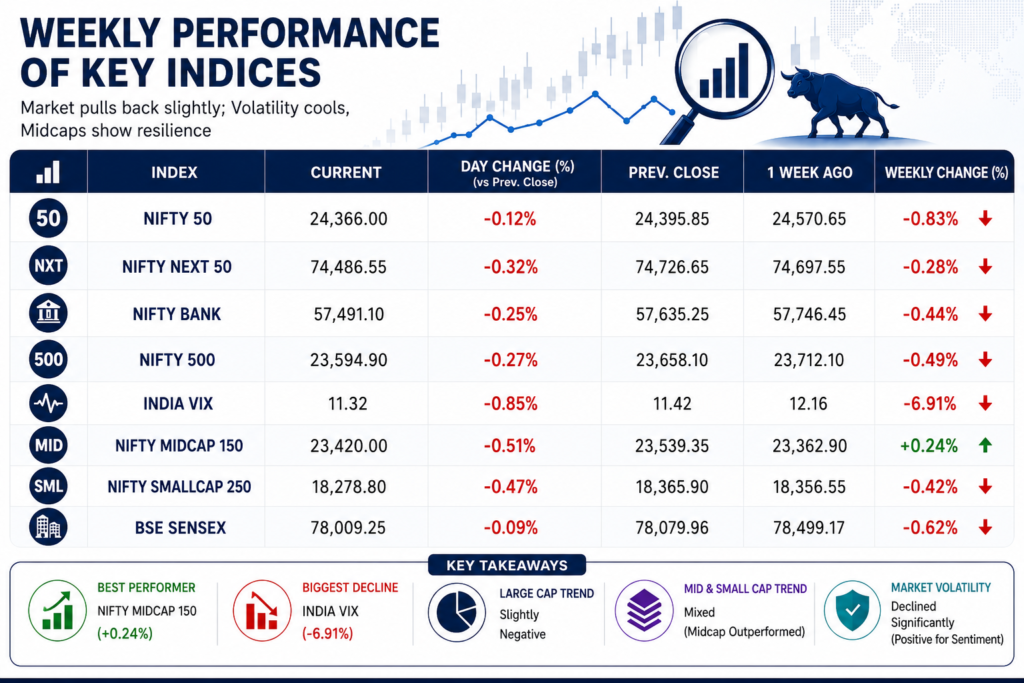
(Source: NSE, BSE)
Key Market Triggers
- Crude Oil Remained A Key Concern: During the week, Brent crude again rose around 6% to settle at $88.52 per barrel, while WTI crude rose around 5.4% to US$82.40 per barrel. The rise was mainly driven by stalled US-Iran ceasefire talks, attacks on oil tankers and the US threat of maintaining a naval blockade of Iran.
- Rupee Remained Under Pressure: The Indian rupee weakened around 0.2% during the week to end at Rs 95.43 per US dollar. Higher crude prices and persistent dollar demand from importers put pressure on the currency, although RBI intervention through state-run banks helped contain the fall and kept the rupee in a narrow range during the week.
- FIIs Remained Net Buyers: Talking about FIIs, they remained net buyers of Indian equities during the week. They bought equities worth around $315 million.
- Inflation Data Remained In Focus: India’s retail inflation rose to 4.45% in July, moving above the RBI’s 4% medium-term target, while wholesale inflation eased marginally to 9.78% from 9.87% in June. The rise in consumer inflation, along with elevated crude prices, kept concerns around the future interest-rate trajectory alive.
- BSE To Enter Nifty 50: Another important development during the week was NSE’s announcement that BSE will replace Wipro in the Nifty 50 from September 30, 2026. The change is part of the benchmark’s semi-annual review and reflects the sharp rise in BSE’s free-float market capitalisation. BSE shares gained following the announcement, while Wipro remained under pressure.
Weekly Sectoral Performance
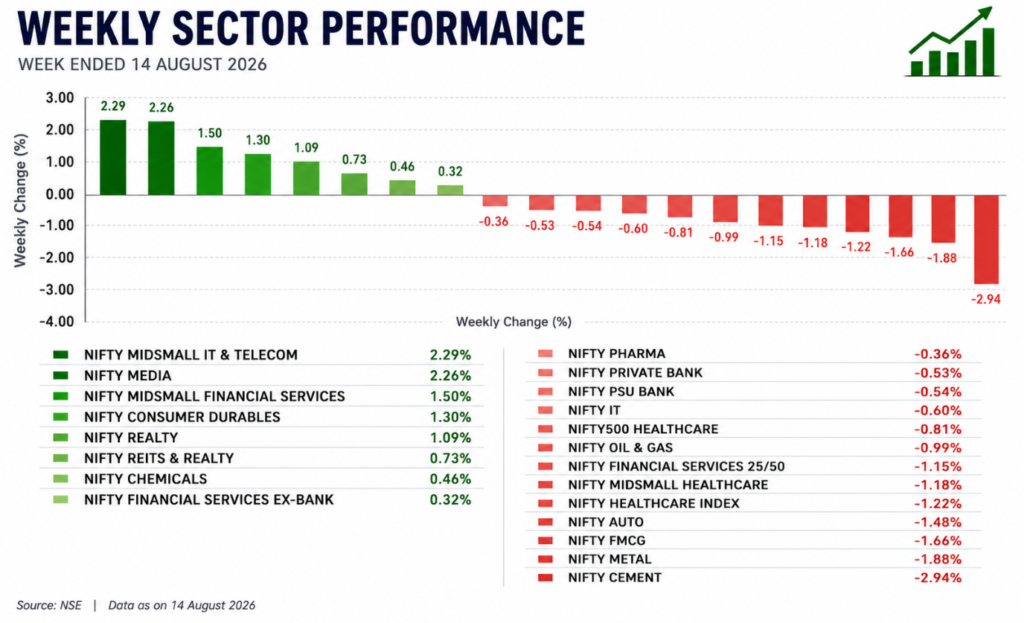
Coming to sectoral performance during the week, Nifty MidSmall IT & Telecom led the gains with a 2.29% rise, followed by Nifty Media, which gained 2.26%. Nifty MidSmall Financial Services also performed well, gaining 1.50% during the week, supported by buying in select stocks despite weakness in the broader financial sector.
On the flip side, Nifty Cement declined the most, losing 2.94% during the week. It was followed by Nifty Metal, which declined 1.88%, and Nifty FMCG, which lost 1.66%.
Wrapping Up
Indian equities ended the week lower as elevated crude prices and geopolitical uncertainty weighed on investor sentiment despite continued domestic institutional buying. The ongoing Q1 earnings season provided stock-specific opportunities, while the rupee remained relatively stable due to RBI intervention. With FIIs remaining net buyers and market volatility staying low, the broader market continues to show resilience. Going ahead, investors will closely track crude oil movements, geopolitical developments, inflation trends, the rupee, and the remaining Q1 earnings announcements for further market direction.
