

In the world of financial markets, there is a persistent myth: that successful trading requires a crystal ball or an extraordinary instinct for predicting price movements.
The most consistent traders are rarely fortune tellers. They are system builders.
Rather than relying on emotions or opinions, systematic traders build structured processes that guide every decision from identifying opportunities to managing risk. At True Turtles, we believe that successful trading is less about predicting the future and more about building a robust framework that can survive any market environment.
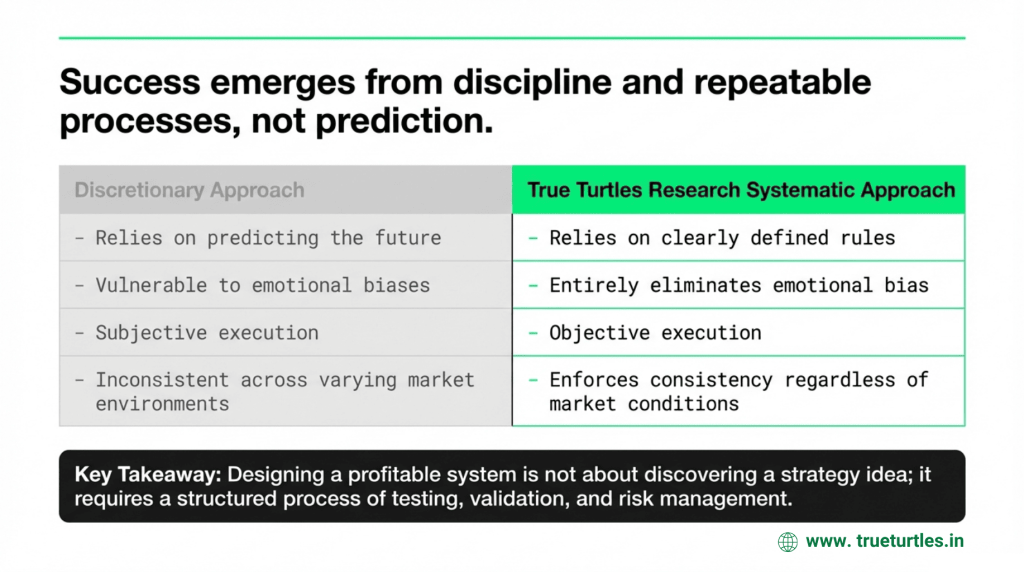
How does a simple trading idea evolve into a reliable, battle-tested strategy? Below is our seven-step framework for developing strategies that are disciplined, resilient, and scalable.
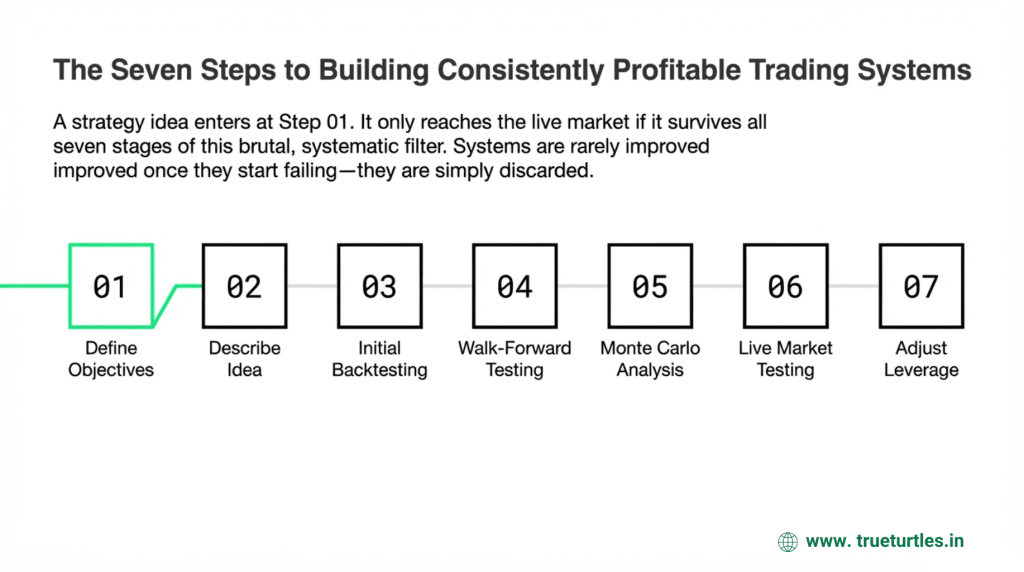
1. Start With Clear Objectives
Every successful trading system begins with a clear definition of success. Before testing any idea, it is vital to establish measurable objectives. These may include:
- Target Annual Return: What is the realistic goal?
- Max Acceptable Drawdown: How much “pain” can the strategy handle?
- Trading Frequency: How often will the system execute?
- Capital Limits: What are the allocation requirements?
Defining these goals at the beginning creates an objective benchmark. If a strategy fails to meet these criteria during testing, it is far easier to discard it early rather than “forcing” it to work later.
2. Blueprint the Trading Idea
Once objectives are defined, the logic of the strategy must be outlined with zero ambiguity. A trading system should be structured so that every rule is repeatable. This includes documenting:
- Markets or asset classes to be traded.
- Timeframes or data intervals (daily, weekly, monthly etc.).
- Precise Entry Conditions and Exit Signals.
- Risk management parameters.
If an idea cannot be explained clearly or implemented systematically, it is unlikely to perform consistently over time.
3. Run the Initial Reality Check (Back testing)
With the rules in place, the strategy is tested against historical market data. Back testing allows us to examine how the strategy would have behaved across different historical cycles (bull, bear, and sideways markets).
The goal is not to find a perfect performance curve, but to determine whether the strategy demonstrates a consistent statistical edge.
4. Test on Unseen Data (Walk-Forward Analysis)
The biggest killer of trading systems is “overfitting”—tuning a system so precisely to past data that it fails when it meets the real world.
Walk-Forward Analysis addresses this by dividing historical data into segments. We optimize the strategy on one segment and then test it on a completely different, “unseen” period. If the strategy cannot perform on data it has never seen before, it lacks genuine robustness.
5. Stress-Test the Strategy (Monte Carlo Simulation)
Even a strategy that performs well in backtests may hide significant risks. Monte Carlo analysis helps uncover these by randomizing the sequence of trades and simulating thousands of potential outcomes. This allows us to evaluate:
- The range of possible returns.
- Worst-case drawdown scenarios.
- Sensitivity to trade sequencing (what if your 10 biggest losers happen in a row?).
Strategies that fail this stress test are often discarded or redesigned to handle more volatility.
6. Conduct Live Market Micro-Testing
Once a strategy passes simulation, it enters the “Acid Test.” This is done via simulated environments or very small position sizes in live markets. Live testing introduces real-world factors that backtests miss:
- Slippage: The difference between expected and actual price.
- Execution Delays: Latency in order filling.
- Psychological Pressure: The reality of managing live capital.
7. Scale the System Carefully
The final stage focuses on determining the appropriate level of capital allocation. Position sizing should always be guided by data, not confidence. By analyzing the data from our Monte Carlo simulations, we can determine exactly how much capital the system can safely deploy without risking the “ruin” of the account.
The Bottom Line
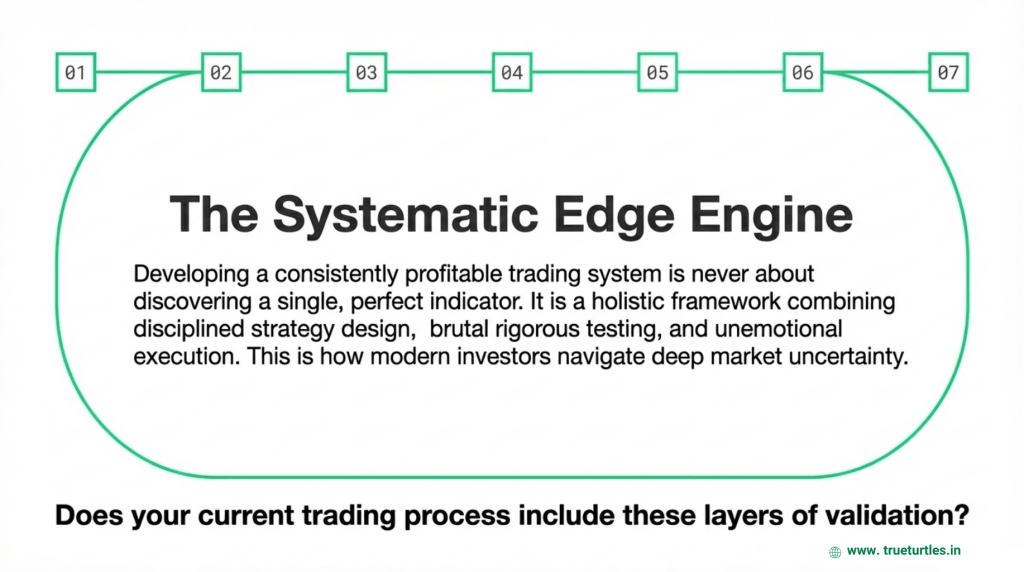
Building a profitable trading system is rarely about discovering a single “perfect” indicator. Instead, it is the result of a disciplined and rigorous development process, one that subjects every idea to multiple layers of testing before real capital is ever at risk.
In markets driven by uncertainty and emotion, a well-designed system becomes one of the most powerful advantages an investor can have.
At True Turtles Research, we prioritize the “Process” over “Prediction”.
